Foundations
Saving and investing are two different jobs
They are constantly discussed as if one were a cautious version of the other. They are not. They do opposite things, they are judged by opposite standards, and using one where the other belongs is the most expensive ordinary mistake in personal finance.
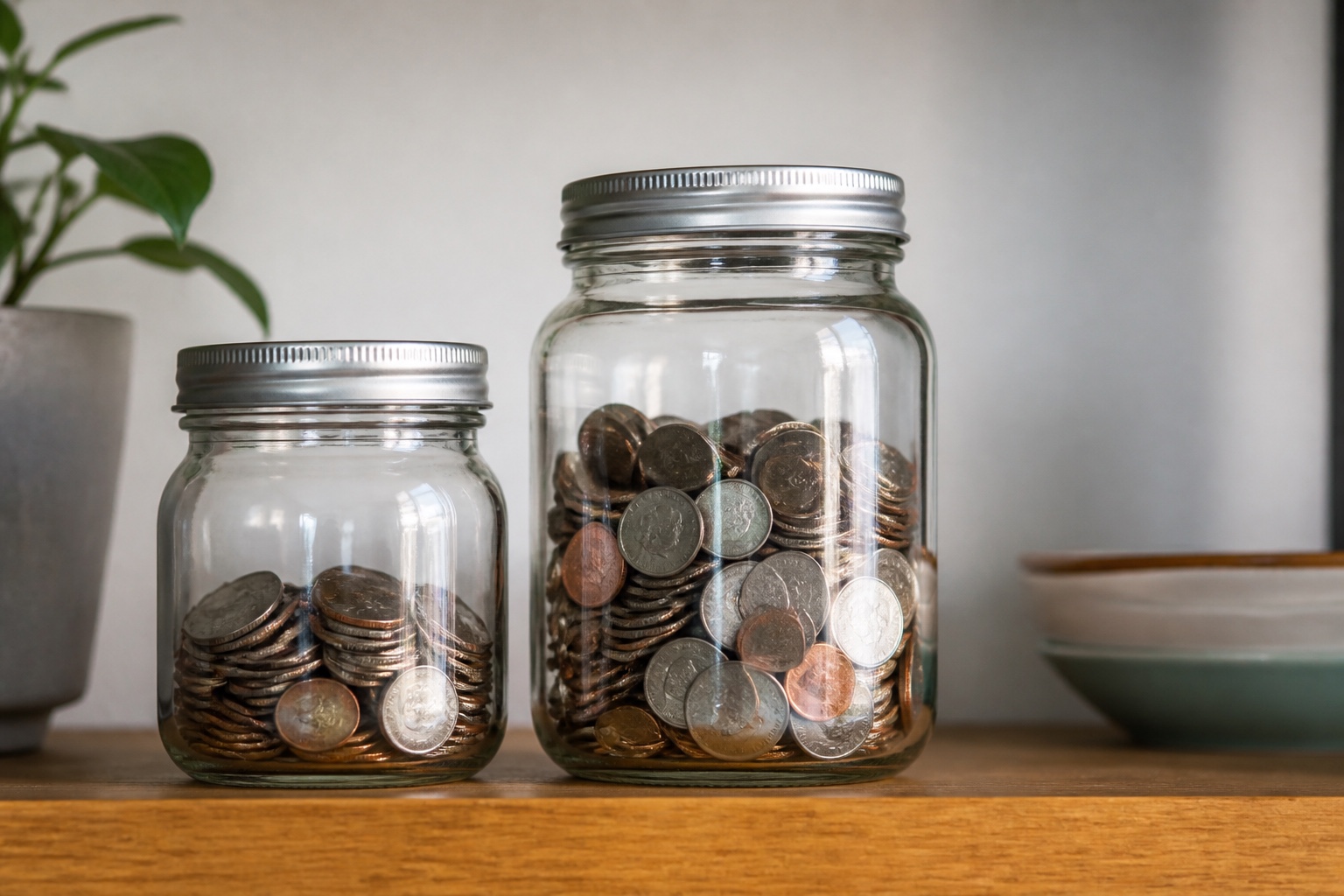
Ask someone whether saving or investing is better and you will get an answer about returns. That is already the wrong frame. It is like asking whether a fire extinguisher is better than a car. They are both useful, they do unrelated things, and the sensible question is which one you need in front of you right now.
The two jobs, stated plainly
Saving is the job of keeping money available. It has to be there, in full, on a day you do not get to choose. Its success condition is that the amount does not move. Growth is a pleasant side effect and never the point.
Investing is the job of letting money grow by allowing it to move. It must be allowed to fall, because a holding that cannot fall cannot reasonably be expected to rise much either. Its success condition is measured in decades, and it is judged by where it ends up rather than what it did in any given year.
Once written that way, the confusion becomes obvious. People put emergency money into investments and are shocked when it is smaller during an emergency, which is a period when many things are down at once. And they leave decade money in a savings account and are shocked, twenty years later, that it buys less than it used to.
When cash is the right answer
Cash wins whenever certainty about the amount matters more than the size of the amount. In practice, three situations.
- The buffer. Money that exists so that a broken car or a lost month of work does not force a sale. Its whole job is being reachable within a day. How to build it, and how big.
- Anything with a date inside about three years. A deposit, a course, a replacement vehicle. A three year horizon is not long enough to reliably absorb a bad stretch, and being 20 percent short in the month you need the money is a serious problem no average return fixes.
- Money you have not decided about yet. Undecided money should sit somewhere it cannot surprise you while you decide.
When cash is the expensive answer
The cost of holding cash is invisible, which is why it is so easy to hold too much of it. It does not appear as a loss on any statement. The balance rises. What falls is what the balance buys.
Ten thousand in a savings account, ten years
- Starting amount $10,000
- Balance after 10 years at 1 percent a year $11,046
- What it buys, if prices rose 3 percent a year $8,219
Arithmetic at fixed rates, not a forecast. The balance genuinely grew by about 1,046. Purchasing power fell by about 1,781, because prices compound too. This mechanism is taken apart in how inflation affects your savings.
That is the trade. Cash guarantees the number and quietly surrenders the value. Investing risks the number in exchange for a chance at keeping the value, and historically that chance has needed years rather than months to show up.
The horizon table
When money is needed decides almost everything about where it should sit. Not your appetite for excitement, not what markets did last year.
| Needed in | The job | What matters most |
|---|---|---|
| Any day now | Buffer | Reachable within a day, amount cannot move |
| Under 3 years | Saving | Certainty of the amount on a known date |
| 3 to 7 years | Mixed, and honestly uncomfortable | How badly a shortfall would hurt on the date |
| Over 10 years | Investing | Cost, contribution and not interrupting |
The middle row is the one nobody likes, and pretending it is comfortable would be dishonest. Between three and seven years there is no clean answer, only a question about consequences: if the money were 25 percent smaller on the date, would the plan bend or break. If it would break, it belongs in the row above.
What getting it backwards costs
Both errors are common, and they hurt in opposite ways.
Investing short term money hurts suddenly and visibly. You need 8,000 for a deposit in eighteen months, the market falls 20 percent in month fourteen, and now you are short by 1,600 with no time to recover. The average annual return over the last century is no comfort at all, because you are not living in the average, you are living on a date.
Saving long term money hurts slowly and invisibly. Nothing bad appears to happen for years. Then twenty years pass and the same balance rents a smaller flat than it would have. Nobody sends a notification about this, which is precisely why it is so common.
The third job nobody names
There is a third use of money that outranks both of the others, and it gets discussed far less because it is not aspirational: paying down expensive debt.
A balance charging 18 percent a year is a guaranteed cost running against an uncertain gain. Use the rule of 72 on it: divide 72 by 18 and you get 4, so that balance doubles roughly every four years if nothing is paid down. No realistic investment return competes with removing a guaranteed 18 percent, which is why clearing that kind of debt usually comes before both saving beyond a small starter buffer and investing anything at all.
The ordering that follows from all of this is the one used across this site: a small buffer, then expensive debt, then a full buffer, then investing. It is set out step by step on the start here page.
Common questions
Can one account do both jobs?
Not well, and the reason is behavioural rather than technical. Money in a single pot gets spent according to whichever job feels most urgent that week. Separating the buffer from the long term money is the cheapest way to stop the two from borrowing from each other.
Is a savings account pointless if it loses to inflation?
No, because its job is not to beat inflation. It is to be exactly the amount you expected on a day you did not choose. Judging a buffer by its interest rate is like judging a spare tyre by its fuel economy, as covered in the emergency fund guide.
How much should sit in cash before I invest anything?
Enough that an ordinary setback does not force a sale, which for most households lands between three and six months of essential spending. The full reasoning, with the arithmetic, is in how much should I save before investing.
What about money for a house deposit in five years?
That sits in the uncomfortable middle row, and the honest treatment is to decide what a shortfall would actually mean. If a delay of a year would be irritating but survivable, some of it can take risk. If the date is fixed by a contract, it is saving money, whatever the potential return.
Figures here are arithmetic at fixed, stated rates, used to show a mechanism rather than to predict anything. Interest rates, inflation and market returns all vary, and none of this takes your obligations or your local tax rules into account.